
Online ads are getting more expensive, and the traffic dividend has long peaked; physical stores are seeing sparse foot traffic, and the faces of customers remain a blur. Is this the operational dilemma you are currently facing? As traditional retail models hit a bottleneck, a brand-new concept has emerged. So, what exactly is New Retail? Far from an empty slogan, it is a data-driven revolution centered on customer experience, deeply integrating online services, offline experiences, and modern logistics—a concept first introduced by Alibaba founder Jack Ma in 2016. Simply put, it no longer separates online and offline but perfectly merges the two to create a value where 1+1>2. This article provides a comprehensive strategic blueprint, from conceptual understanding to practical business execution, to help you fully grasp New Retail and master the retail survival rules for the next decade.
Why You Must Understand New Retail Now: The Dual Dilemma of E-commerce and Physical Stores
You might ask, why is this transformation so urgent? Because both pure e-commerce and traditional physical stores have fallen into their respective growth traps, and New Retail was born precisely to solve these pain points.
The bottleneck of pure e-commerce lies in the fact that the traffic dividend it once relied on is completely exhausted. Online Customer Acquisition Costs (CAC) are soaring year by year, and rising ad fees on major platforms are severely squeezing profit margins. More importantly, online shopping lacks a true “sense of experience.” Consumers cannot touch, try on, or feel the products, making it increasingly difficult to build brand trust.
On the other hand, the crisis for traditional physical stores is also escalating. With the rise of the “stay-at-home economy” and shifting consumer habits, simply waiting for customers to walk through the door no longer works. The biggest challenge comes from data gaps—store owners watch people come and go but have no idea who they are, where they come from, what they like, or why they didn’t make a purchase. This lack of information turns every interaction into a one-time touchpoint, making it impossible to accumulate sustainable data assets. We once interviewed a clothing store owner with over 20 years of experience who lamented: “Before the pandemic, we survived on regular customers. After the pandemic, I realized I don’t even know who my customers are, let alone how to get them back.”
The emergence of New Retail aims to bridge this growing divide. It breaks down the barriers between channels, allowing businesses to enjoy both the broad reach of online networks and the deep immersion of offline experiences, ultimately integrating data assets from both sides to achieve true O2O/OMO integration.
After understanding the necessity of transformation, we need to dive into the underlying logic of New Retail. It is not just about stacking technology; it is a complete reconstruction of the “People, Products, and Place” triangle.
The Core of New Retail: Deconstructing the Revolutionary Shift in "People, Products, and Place"

To truly grasp New Retail, you must master its core mindset: reconstructing the commercial triangle of “People, Products, and Place.” The logic of traditional retail was “Products → Place → People”—businesses produced goods, distributed them to channels, and waited for consumers. In the New Retail era, this sequence is entirely flipped.
The core shift is moving from a “Product-centric” approach to a “Customer-centric” one.
- People (Consumer): In the vision of New Retail, customers are no longer just final buyers; they are data providers, experience participants, and co-creators of brand value. The goal is to build a 360-degree customer profile across various touchpoints to truly understand individual preferences and needs.
- Products (Goods): The production logic shifts accordingly. Mass standardized production is gradually making way for a data-driven C2B (Consumer-to-Business) model, essentially “producing based on sales.” Companies predict market demand using consumer data, even offering personalized customization, thereby reducing inventory waste and creating higher product value.
- Place (Scene): The definition of “Place” has vastly expanded. It is no longer limited to an official website or a brick-and-mortar shop, but any “scene” that can reach the consumer. Your website, physical store, LINE Official Account, social media, live streams, and even partner KOL pages are all “Places” in New Retail.
This customer-centric network structure allows businesses to flexibly mobilize “Products” and “Places” to serve “People,” creating an unprecedentedly seamless experience. This naturally leads us to the two key operating models for achieving this: O2O and OMO.
The Two Key Models of New Retail: What is the Real Difference Between O2O and OMO?
When discussing New Retail, O2O and OMO are the most commonly heard terms. Many confuse the two, but conceptually, they are worlds apart. Understanding the O2O vs. OMO difference is a crucial step to mastering New Retail.
| O2O (Online to Offline): Focused on Traffic Diversion, Data remains in Silos
The core of O2O is “traffic diversion.” It refers to channeling online traffic to physical stores for consumption (e.g., buying a dining voucher online and redeeming it at a restaurant), or vice versa, directing offline customers online to complete a specific task.
However, O2O’s biggest flaw is that online and offline data remain disconnected. If you buy a voucher online using Account A and redeem it offline, the store only knows the voucher was used; they don’t know it was you. Membership data, purchase history, and inventory operate independently across channels, creating “data silos” where businesses cannot piece together a complete customer profile.
| OMO (Online-Merge-Offline): Data Integration for a Seamless Experience
For OMO, the keyword is “Merge,” representing the ultimate state of online-offline integration. It strives to provide customers with a consistent and continuous seamless experience across all channels.
Under the OMO model, whether a customer interacts with the brand via the website, APP, or physical store, their membership identity is unified. This means:
- Online coupons can be redeemed at offline stores.
- Reward points earned in-store can be used to discount online purchases.
- Items added to an online shopping cart can be tried on and checked out directly at a physical store.
The core of OMO is “data convergence.” By connecting all channel data through unified systems, businesses achieve a Single Customer View. This not only optimizes the customer experience but lays a solid foundation for precision marketing and smart decision-making.
How to Implement New Retail Step-by-Step? A 4-Stage Blueprint for SMEs
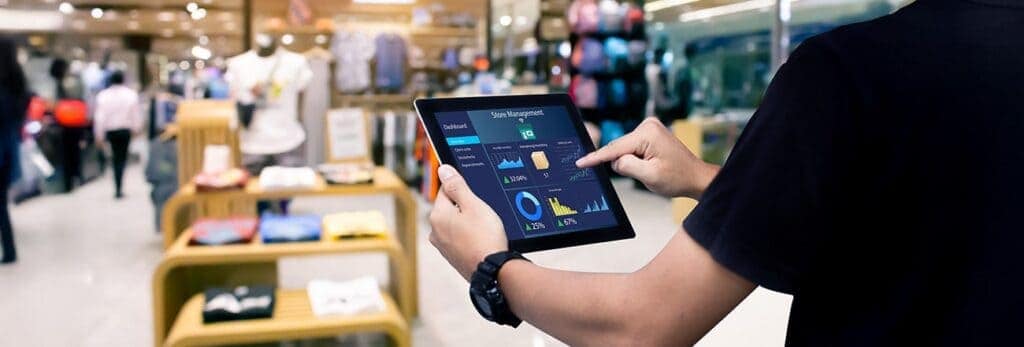
Many SME owners believe New Retail is exclusively for giant corporations. That’s a myth. With the right approach, you can initiate this transformation in phases and at a low cost. Here is our 4-stage practical blueprint designed for you.
| Stage 1: Digitize Data
This is the foundational step. The goal is simple: transform previously untrackable offline behaviors into digital data.
- Actionable Step: Implement a Cloud POS system that does more than process payments—it records detailed transaction data. Simultaneously, establish a loyalty program and actively encourage in-store customers to join your brand’s messaging app (like LINE/WhatsApp). For example, offer a small discount or freebie at checkout if they scan a QR code to become a member, turning offline “passersby” into reachable online “friends.”
| Stage 2: Integrate Channels
Once you have data from various channels, the next challenge is breaking down “data silos.”
- Actionable Step: Adopt tools that connect data across your website, POS, and messaging apps, such as a CRM (Customer Relationship Management) system or a more advanced CDP (Customer Data Platform). The goal is to ensure synchronized membership profiles, purchase histories, and crucially, inventory synchronization, avoiding the embarrassment of showing an item as in-stock online when it’s sold out in-store.
| Stage 3: Optimize Experience
With data integrated, you can start creating truly seamless experiences, effectively practicing omnichannel retail.
- Actionable Step: Design various OMO scenarios tailored to your business. For instance, launch a “Buy Online, Pick Up In-Store” (BOPIS) service, which offers convenience while driving foot traffic. If an item is out of stock in-store, staff can immediately help the customer order it online for home delivery. Ensure online-issued coupons are easily redeemable at any physical branch.
| Stage 4: Intelligentize Decisions
This is where New Retail maximizes its value, turning data from mere records into an engine for business growth.
- Actionable Step: By analyzing the integrated data, you can execute precision audience segmentation marketing, pushing relevant content to specific customer segments based on their habits. You can also forecast sales trends more accurately, optimize procurement, and move toward the C2B “produce based on sales” model, realizing truly data-driven decision-making.
Challenges of Implementing New Retail, Solutions, and How to Measure KPIs
Transitioning to New Retail is a profound organizational shift. Anticipating challenges and preparing solutions will save you immense effort. You also need scientific metrics to measure your success.
| Top 3 Common Challenges and Solutions:
- Tech & Budget Barriers: System integration sounds expensive.
- Solution: You don’t need to do it all at once. Today, many SaaS (Software as a Service) platforms and modular CRMs allow you to pay monthly and deploy in stages, drastically lowering upfront investments.
- Internal Organizational Resistance: The most common issue is sales attribution. Store staff might resist directing customers online, fearing the e-commerce department will steal their commissions.
- Solution: Establish a fair profit-sharing system. For example, use referral codes or staff-exclusive links. If a member registered by a store employee makes an online purchase, that employee still receives a percentage of the commission, turning resistance into motivation.
- Lack of Data Application Skills: Collecting massive data but not knowing how to use it.
- Solution: Start by looking at simple dashboards or partner with agencies that provide data analysis. Simultaneously, gradually cultivate your internal team’s data literacy so data genuinely guides your decisions.
| Key Performance Indicators (KPIs) to Measure Success:
Ditch the old mindset of looking at single-channel revenue. These KPIs better reflect the true value of New Retail:
- Omnichannel Customer Lifetime Value (LTV): Track a single customer’s total spending across all channels (online + offline). You’ll find that omnichannel shoppers have a significantly higher LTV than single-channel shoppers.
- Cross-Channel Conversion Rate: Measure how much offline sales are driven by online marketing campaigns, and vice versa.
- Member Binding & Activation Rate: What percentage of offline customers successfully convert to online members? What is their engagement and repurchase frequency?
- Inventory Turnover Rate: Following omnichannel inventory synchronization, has overall inventory efficiency improved and the ratio of dead stock decreased?
The Future of New Retail: Beyond OMO to Social Commerce and AI Personalization
New Retail’s evolution won’t stop at OMO. Driven by tech advancements and shifting behaviors, new trends are sketching the future of the retail industry.
First is the rise of Social Commerce. Platforms from Facebook and Instagram to TikTok and LINE are rapidly becoming fully functional transaction hubs. Blending live-stream selling with KOL group buys, social commerce creates an instant, trust-based shopping experience, becoming a vital battlefield for acquiring and converting new audiences.
Second, AI-Driven Hyper-Personalization will push customer experience to the extreme. Future recommendation engines won’t just look at past purchases; they will factor in real-time browsing, geo-location, and even the day’s weather and mood to provide truly unique AI-personalized product recommendations, making every consumer feel like a brand VIP.
Lastly, Sustainable Retail is an undeniable trend. New Retail’s C2B model uses data to predict demand, enabling precise production that severely cuts inventory waste and carbon footprints, aligning perfectly with global ESG (Environmental, Social, and Governance) principles and offering a new core value proposition for brands.
Conclusion
Returning to the original question: What is New Retail? It is not just a business model, but the inevitable evolution of retail in the digital age. Its core is a radical “Customer-centric” mindset that uses data to flawlessly merge online and offline, creating a seamless, convenient, and personalized ultimate experience.
From understanding traditional retail’s dilemma to reconstructing “People, Products, Place”; from clarifying O2O vs. OMO to mastering the 4-stage blueprint, we hope this guide clears the fog. The path of transformation is challenging, but the rewards are colossal. Start evaluating your first step today and ignite your New Retail revolution!
Frequently Asked Questions (FAQ)
A: Absolutely. New Retail is primarily a shift in mindset, not just expensive tech investments. Start with simple, low-cost steps: use a messaging app (e.g., WhatsApp/LINE Business) to manage regular customers and distribute coupons, and link a basic online ordering site to secure your own first-party customer data.
A: Think of them as an evolutionary chart. O2O is the baseline (focused on traffic diversion). Omnichannel retail means you have multiple sales channels (website, app, store). OMO is the ultimate goal, where data and experiences across all channels are “merged” so the customer feels they are interacting with “one” brand, not separate channels. New Retail is the overarching term for the business strategy, organizational structure, and tech logic required to achieve OMO.
A: Not at all; their role becomes more crucial and diverse. Under the trend of online-offline integration, physical stores will transform from mere “points of sale” into brand “experience centers,” “community hubs,” and “after-sales service stations.” Their core value lies in creating warm, deep interactions and brand immersion that digital channels simply cannot replace.